The best heavy duty truck hoods provide vehicle-specific fitment, durable construction, secure mounting compatibility, and reliable replacement availability. Choosing between OEM and aftermarket options requires verifying the truck’s make, model, year, and component configuration. Fleet operators should also consider material quality, freight lead times, painting requirements, and total installation costs before purchasing.
Key Takeaways
- Verify vehicle compatibility: Confirm the make, model, year, VIN, hood dimensions, and mounting configuration before ordering.
- Inspect construction qualityI: Strong inner structures, secure reinforcement attachments, and properly finished surfaces help prevent premature cracking, structural failure, and paint defects.
- Compare hood materials: Fiberglass, METTON plastic composites, and aluminum have different characteristics in weight, durability, repairability, and refinishing requirements.
- Check regional parts availability: Guardian Heavy Duty stocks aftermarket collision parts, including replacement hoods, at its Greeley warehouse, helping customers avoid unnecessary freight costs and shipping delays.
- Consider complete replacement services: Fleet Collision Services offers replacement hood sourcing, painting, installation, and a loaner hood program for eligible commercial trucks.
What Are the Best Heavy Duty Truck Hoods for Commercial Vehicles?
Quick Summary: The best heavy-duty truck hood provides vehicle-specific fitment, compatible mounting alignment, and structural durability. Selection requires comparing fiberglass, METTON composite, and aluminum construction, inner reinforcement quality, surface paintability, replacement availability, freight lead times, and total installed costs, including preparation, painting, hardware, and installation.
There is no single replacement hood suitable for every semi-truck or commercial vehicle. The correct choice depends on the manufacturer’s specifications, vehicle configuration, construction quality, and intended application.
Fleet Collision Services, headquartered in Greeley, Colorado, has served commercial vehicle owners under various owners for more than four decades. We help customers evaluate replacement hood options and source aftermarket collision components through Guardian Heavy Duty.
Key Factors When Selecting Heavy-Duty Commercial Truck Hoods
Selecting a heavy-duty truck hood begins with confirming vehicle compatibility and evaluating construction quality. A replacement that looks identical to the original may have different mounting locations, dimensions, reinforcement structures, or component openings.
Verification Checklist: Make, Model, Year, and VIN
Before requesting a replacement hood, gather:
- Manufacturer and model: Identify the exact truck application.
- Production year: Confirm the model year and relevant production changes.
- Vehicle identification number: Use the VIN to help identify the original vehicle configuration.
- Existing hood specifications: Record available part numbers, dimensions, and mounting details.
- Component configuration: Verify grille, headlight, air-intake, and accessory openings.
- Photographs: Document the existing hood, hinges, latches, and attachment points.
A VIN helps establish vehicle specifications but does not independently guarantee aftermarket compatibility. Previous modifications or replacement components may require additional verification.
Hood Selection Comparison Matrix
| Selection factor | What to verify | Why it matters |
| Vehicle application | Make, model, year, VIN | Reduces incorrect orders |
| Hood dimensions | Length, width, geometry | Supports proper alignment |
| Mounting points | Hinges, pivots, latches | Supports secure attachment |
| Inner structure quality | Reinforcement strength, bonding, attachment integrity | Weak inner structures can separate or break over time |
| Surface finish and paintability | Surface smoothness, pinholes, cracks, preparation requirements | Poor finishes can cause paint craters, visible defects, and spider cracking |
| Material | Fiberglass, METTON composite, aluminum | Affects weight, durability, and repairability |
| Component openings | Grille, lights, air intakes | Supports equipment compatibility |
| Assembly contents | Hardware and included parts | Identifies additional purchases |
| Freight availability | Stock, packaging, delivery | Supports repair scheduling |
Why Inner Structure Quality and Paintability Matter
An aftermarket hood’s exterior appearance does not always reveal its construction quality. Internal reinforcements help maintain structural integrity, support mounting components, and withstand repeated opening, closing, and road vibration.
Poorly bonded or inadequately reinforced inner structures can loosen, separate, or fracture over time, potentially resulting in premature hood failure.
Surface quality is equally important. Manufacturing defects such as pinholes, uneven finishing, or poorly prepared surfaces can create problems during painting.
Pinholes may produce small craters in the finished paint, while underlying defects or material stress can contribute to spider cracking over time.
Evaluating these characteristics before purchasing helps buyers avoid additional preparation costs, premature deterioration, and unnecessary repairs.
Expert Tip: Prioritize Fitment and Construction Quality Over Appearance or Price
Even hoods manufactured for the same truck brand can differ by model, production year, dimensions, and mounting configuration. Before ordering, verify the supplier’s application specifications, inspect the quality of internal reinforcements, and evaluate the surface finish. A lower purchase price may not represent savings if the hood requires extensive preparation or develops structural problems.
OEM vs. Aftermarket Heavy-Duty Truck Hoods
A properly manufactured aftermarket hood can be a suitable alternative to an OEM replacement when it meets the truck’s fitment, construction quality, and installation requirements.
OEM hoods follow original manufacturer specifications. Aftermarket hoods are produced by independent suppliers and may offer different pricing, sourcing, or availability options.
OEM vs. Aftermarket Feature Comparison
| Feature | OEM hood | Aftermarket hood |
| Manufacturer | Original equipment source | Independent manufacturer |
| Fitment | Original application specifications | Requires application verification |
| Inner structures | Manufacturer-specified construction | Quality varies by manufacturer |
| Surface finish | Varies by product | May require additional preparation |
| Availability | Depends on OEM supply | Depends on aftermarket inventory |
| Pricing | Model-dependent | May offer cost savings |
| Warranty | OEM-specific terms | Supplier-specific terms |
Neither option automatically guarantees better durability or immediate availability.
Fleet managers should compare the complete replacement expense, including freight, surface preparation, painting, mounting hardware, and installation, rather than the hood’s purchase price alone.
Materials Breakdown: Fiberglass, METTON Composites, and Aluminum
Heavy-duty truck hoods are commonly constructed from fiberglass, engineered plastic composites, or aluminum. Each material offers different characteristics in weight, durability, impact resistance, repairability, and refinishing requirements.
Fiberglass Truck Hoods
Fiberglass hoods use glass-fiber reinforcement within a resin structure, providing a combination of strength, manageable weight, and repairability.
Fiberglass can often be repaired when damage is localized and the underlying reinforcement remains suitable for restoration. However, cracks, delamination, and damaged mounting areas require careful evaluation.
Construction quality matters. Poor bonding between the outer shell and internal reinforcements can lead to separation or cracking over time.
METTON Plastic Composite Truck Hoods
Many heavy-duty truck hoods use METTON®, an engineered plastic composite material designed to provide lightweight construction and accommodate complex hood shapes.
One advantage of METTON and similar plastic composites is reduced weight, which can make large hood assemblies easier to handle.
However, plastic composite hoods can present durability and repair challenges.
- Cracking: Certain plastic hood constructions may be more susceptible to cracking than comparable fiberglass designs, depending on material formulation, thickness, and impact conditions.
- Repair complexity: Plastic composites may require specialized repair materials, preparation methods, and manufacturer-approved procedures.
- Damage assessment: Cracks around mounting points or reinforced sections may make replacement more practical than repair.
- Refinishing: Proper surface preparation and compatible coating systems are necessary for reliable paint adhesion.
Buyers should evaluate the specific material and hood construction rather than assuming that lighter weight automatically means greater durability.
Aluminum Truck Hoods
Aluminum hoods are another important option in heavy-duty commercial trucking, particularly on certain truck models and older vehicle configurations.
Aluminum offers corrosion resistance, relatively low weight, and the potential for repair when damage is appropriate for metalworking techniques.
Unlike fiberglass and plastic composites, aluminum requires metal-specific repair methods and careful assessment of deformation, cracking, and attachment points.
Common considerations include:
- Dent repair: Some aluminum hood damage can be repaired through appropriate metalworking techniques.
- Cracking and fatigue: Repeated stress around hinges, mounting points, and reinforced areas can contribute to cracking.
- Corrosion: Aluminum resists red rust but can experience oxidation and galvanic corrosion, particularly where dissimilar metals contact one another.
- Painting: Proper cleaning, surface preparation, and compatible primers are necessary for durable refinishing.
At Fleet Collision Services, we work with commercial truck hoods made from fiberglass, plastic composites, and aluminum. Our team evaluates the material, damage, and repair requirements to help determine an appropriate repair or replacement approach.
Weather Hazards and Freight Sourcing Across Northern Colorado
Commercial trucks traveling Northern Colorado’s major freight corridors face environmental exposure that can contribute to hood deterioration and replacement needs.
Interstate 25 connects freight operations between Denver, Fort Collins, and Cheyenne, while US Highway 85 and US Highway 34 support regional commercial transportation around Greeley.
Relevant operating hazards include:
- Hailstorms: Can damage exterior panels and painted surfaces.
- Road debris: May chip finishes, crack fiberglass, or damage grille surrounds.
- Strong winds: Increase aerodynamic loading and can aggravate existing damage or loose components.
- Snow and ice: Introduce seasonal exposure and maintenance challenges.
How Does Regional Parts Availability Affect Hood Replacement?
Regional parts inventory can reduce dependence on distant suppliers when the correct replacement hood is available locally.
Heavy-duty truck hoods are large components that can be expensive to ship. Freight charges may add substantially to the total replacement cost, particularly when oversized packaging or long-distance transportation is required.
Having compatible hoods stocked in Greeley can help customers avoid cross-country shipping delays and significant freight expenses.
For fleet operators serving Colorado and Southern Wyoming, checking regional inventory before arranging long-distance freight can simplify replacement planning and help reduce downtime.
Sourcing Aftermarket Hoods via Guardian Heavy Duty
Guardian Heavy Duty provides aftermarket collision parts through Fleet Collision Services, with replacement hoods and other components stocked locally in Greeley, Colorado.
Guardian Heavy Duty’s inventory includes replacement hoods, bumpers, grilles, fairings, headlights, and other commercial truck collision components.
Unlike suppliers that must order every replacement hood from an out-of-state warehouse, Fleet Collision Services maintains local inventory to support faster parts access when compatible components are available.
Customers can explore Guardian Heavy Duty replacement hoods and parts inventory or contact our team to confirm compatibility, pricing, and availability.
Our Greeley facility also features a 60-foot Garmat downdraft paint booth for large commercial vehicle refinishing projects.
Fleet Collision Services serves commercial vehicle owners throughout Colorado, Southern Wyoming, and across the United States. Customers can also read our local client reviews in Greeley.
Critical Steps Before Installing a Replacement Truck Hood
Proper hood replacement requires more than confirming fitment. New replacement hoods often require surface preparation, painting, and component installation before they are ready for service.
Coordinating these steps at the same repair facility can reduce transportation requirements, simplify scheduling, and help minimize downtime.
Alignment, Latching, and Component Transfer
Before returning a truck to service, technicians should verify:
- Hinge and pivot alignment.
- Primary and secondary latch operation.
- Hood clearance around the cab and bumper.
- Grille, headlight, and accessory fitment.
- Wiring and mounting hardware.
- Manufacturer-specified fastener requirements.
- Safe hood opening and closing operation.
A hood that does not latch securely or interferes with surrounding components requires correction before the vehicle operates.
Painting and Refinishing New Truck Hoods
Many aftermarket replacement hoods arrive unfinished or primed and require professional painting before installation.
The refinishing process may include inspecting the hood’s surface, correcting manufacturing imperfections, preparing the substrate, applying compatible coatings, and matching the truck’s existing paint finish.
Paintability is especially important when evaluating aftermarket hood quality. Pinholes, surface irregularities, and underlying material defects can increase preparation time or contribute to visible paint problems after installation.
At Fleet Collision Services, we can coordinate replacement hood sourcing, painting, and installation at our Greeley facility.
Through Guardian Heavy Duty, we stock aftermarket replacement hoods and other collision components locally. Our facility also features a 60-foot Garmat downdraft paint booth designed to accommodate large commercial vehicles and components.
Having access to replacement hoods and professional refinishing at the same facility can save customers time and money by reducing separate vendor coordination, additional transportation, and scheduling delays.
Customers can contact Fleet Collision Services at (970) 356-2208 to discuss hood availability, painting requirements, and installation services.
Fleet Collision Services Loaner Hood Program
Fleet Collision Services offers temporary loaner hoods for eligible trucks while their original hoods are being repaired or replaced.
Our loaner hood program is designed to help qualifying commercial vehicles remain operational during hood-specific repair work.
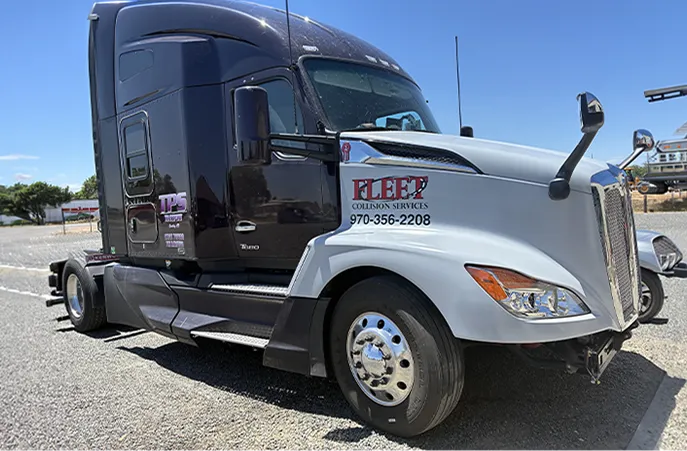
We maintain more than 20 loaner hoods for select Peterbilt, Kenworth, Freightliner, Volvo, and International models, with additional hoods being added to the collection. Availability depends on the truck’s exact make, model, and year.
How the Loaner Hood Process Works
- Contact our shop: Provide the truck’s make, model, year, and photographs of the damage.
- Confirm availability: Our team checks whether a compatible loaner hood is available.
- Install the temporary hood: If eligible, we fit the loaner while repairing the original hood or ordering a replacement.
- Complete the repair: Our team repairs or replaces the original hood and completes the necessary finishing work.
- Schedule the final swap: Return the truck to have the repaired or replacement hood installed.
A typical hood swap takes a few hours, and we recommend allowing a morning or afternoon for the appointment.
Loaner Hood Eligibility and Fees
The program is best suited to trucks with damage primarily affecting the hood. Certain vehicles with minor front-end damage may also qualify if they remain safe to operate.
Trucks requiring extensive cab or suspension repairs generally need to remain at the shop.
The program’s associated charge is the additional labor required for hood swaps. Loaner hoods must be returned within five days after repairs are completed to avoid daily rental fees.
Customers must also sign a liability waiver and are responsible for damage incurred while using the loaner hood.
To check eligibility, visit our commercial truck loaner hood program page or call (970) 356-2208.
Frequently Asked Questions
How much does a replacement heavy duty truck hood cost?
Replacement hood costs vary by manufacturer, model, material, construction quality, and assembly contents. Request a vehicle-specific estimate that includes freight, surface preparation, painting, hardware, and installation.
Can an aftermarket hood replace an OEM semi-truck hood?
Yes, provided the aftermarket hood meets the truck’s application, construction quality, and installation requirements. Confirm dimensions, mounting points, inner reinforcement quality, and component compatibility before ordering.
Do replacement truck hoods come painted?
Many replacement hoods arrive unfinished or primed and require professional painting. Fleet Collision Services can source, prepare, paint, and install replacement truck hoods at our Greeley facility, helping reduce transportation and coordination costs.
Can I use a loaner hood while my truck hood is being replaced?
Fleet Collision Services offers temporary loaner hoods for qualifying commercial trucks, subject to fitment and availability. Contact our Greeley shop with your truck’s make, model, year, and damage information to determine eligibility.
Fleet Collision Services is a commercial truck collision and body repair company headquartered in Greeley, Colorado, serving fleet managers, trucking companies, independent owner-operators, and commercial vehicle owners throughout Colorado, Southern Wyoming, and across the United States. We provide specialized commercial vehicle body repair, collision repair, frame repair, painting and refinishing, complete restorations, fabrication, hail repair, and related services for heavy-duty and commercial vehicles. Our Guardian Heavy Duty offering includes aftermarket collision parts such as replacement hoods, bumpers, grilles, fairings, and other components, while our loaner hood program supports eligible customers with specific hood replacement needs. Our Greeley facility is equipped for large commercial vehicle repairs, including a 60-foot downdraft paint booth.